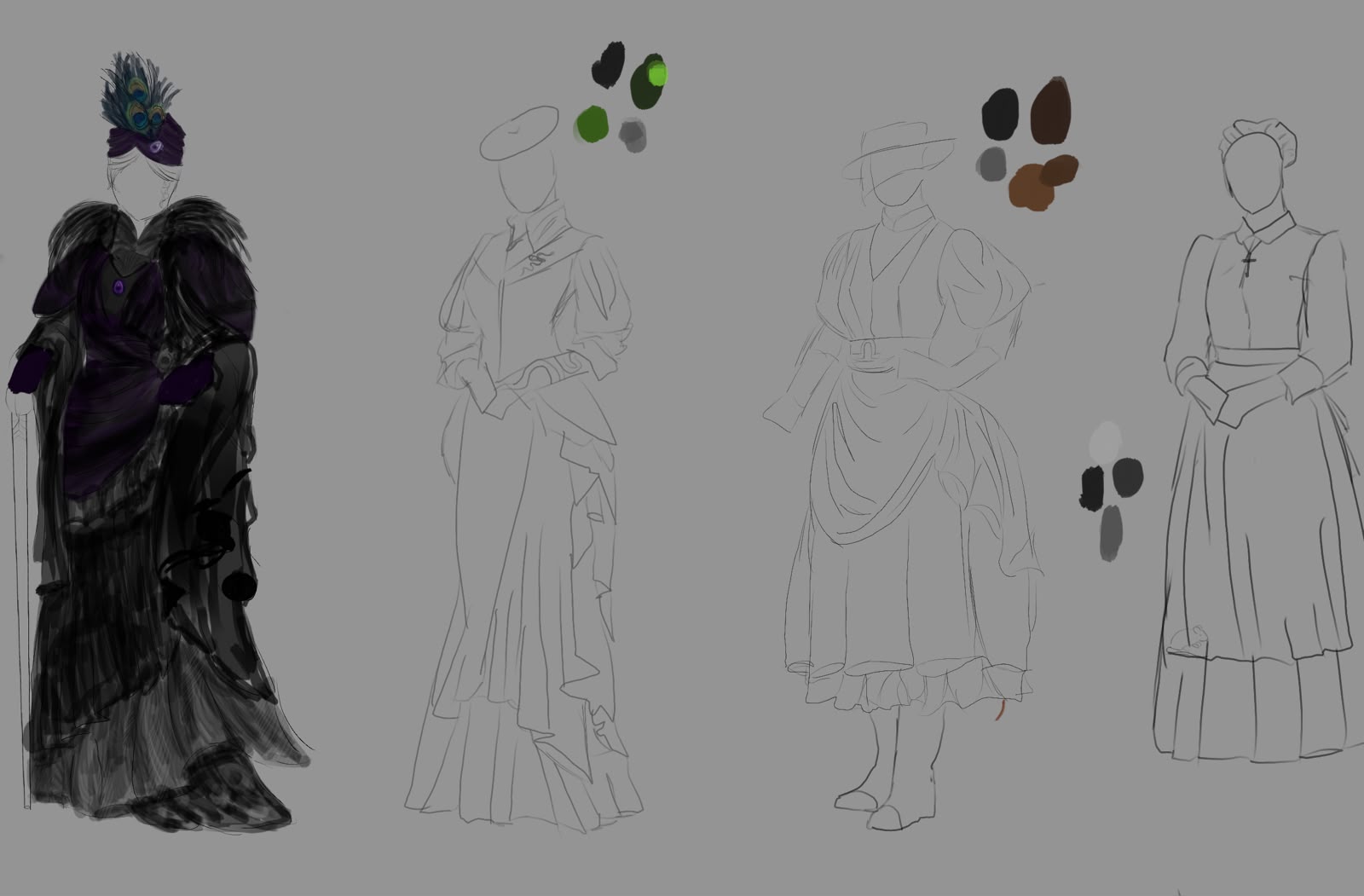
How the Characters Began
As I said in my previous post, the original story idea was triggered by an IHOP sugar rush. I had an idea of the setting (Victorian era) and the topic (family funeral and related dynamics), but it was really the characters that took the idea and made it into a story.
I really didn’t develop elaborate mood boards or a detailed visual plan during the writing process; much of my creative direction came down to following the atmosphere and the characters’ personalities as I imagined them. What surprised me was how often those characters managed to surprise me!
When I first started writing The Most Deserving, my initial goal was fairly practical: I need approximately nine roles, with the possibility of ensemble roles, to accommodate the people who would be involved in the production if it was produced at my school.
First Steps
The first fully developed character ended up being Reginald Pemberton-Wick, an estranged cousin whose inclusion was originally suggested by a friend.
From there, I began building the rest of the cast.
I gave each character a flaw and, in my earliest of drafts, even assigned them a color and an animal to help guide their personalities. I ultimately didn’t follow those associations particularly closely, but they were part of my initial experimentation with character development.
Reginald, as the first well-formed character in my mind, was also probably the easiest character for me to write. He’s greedy, extravagant, and completely honest about it, which makes him particularly entertaining to me. He doesn’t pretend to be morally superior to anyone else, and I think that self-awareness makes him more interesting than a character who is simply greedy and dishonest.
Edmund, the Duke, was considerably more difficult. Despite having relatively few lines, he’s an incredibly important character because the entire play revolves around his death and the different relationships people had with him.
A Life of Their Own
When I then think of the emotional center of the play, to me, it’s the different relationships each character had with the Duke, Edmund.
Although the family spends much of the story arguing over his inheritance, the conclusion brings them all together over tea.
I wanted the audience to come away feeling some sympathy for them, despite their flaws and ridiculous behavior.
Ultimately, the play became less about following a predetermined plan and more about discovering what the characters would do, how they would interact, and what their relationships revealed about them. What I found was that the characters began to “write themselves” the further I got.
More about that in my next post.